Section 278 Knowledge Hub
Practical guidance on Section 278 agreements, highway design, approvals, costs, bonds and adoption, from the UK highways specialists.

Trusted by Developers, Housebuilders & Local Authorities Across the UK
Residential & Commercial Developments
Retail & Industrial Sites
Schools & Public Sector Projects
HIGHWAY ENGINEERING & STATUTORY COMPLIANCE
Complete Section 278 Framework & Delivery
Navigate public highway alterations with end-to-end technical, legal, and operational guidance across all core delivery stages.
Section 278 Basics
Core statutory framework under Highways Act 1980 governing developer-funded permanent modifications to existing public highway infrastructure.
Highway Design & Swept Path Analysis
Geometric road alignment, junction modeling, visibility splays, drainage engineering, and AutoTrack simulations for refuse and emergency vehicles.
Technical Approvals & Council Liaison
Comprehensive submission packages, Road Safety Audits (RSA Stages 1 & 2), and proactive negotiations with Local Highway Authority engineers.
Legal Agreements & Bonds
Drafting Section 278 deeds, surety bond calculation, land dedication covenants, commuted sums settlement, and easement protection clauses.
On-Site Construction
Appointed contractor management, NRSWA Section 50/171 licensing, traffic management phasing, utility diversions, and site supervision.
Inspections & Adoption
Provisional Certificate issuance, 12-month maintenance period management, snagging rectifications, and Final Certificate of Adoption with bond discharge.
Costs, Timescales & Delays
Risk profiling for local council fees, bond costs, statutory undertaker lead times, seasonal delivery constraints, and programme critical paths.
HIGHWAY & INFRASTRUCTURE INSIGHTS
Expert Resources for Highways Agreements
Practical breakdowns, statutory workflows, and compliance timelines to help developers and civil engineering teams keep projects on schedule.

COMPREHENSIVE GUIDE
The Complete Guide to Section 278 Agreements
Master the legal framework under the Highways Act 1980, technical approval requirements, highway authority bonds, and handover protocols for off-site junction alterations.
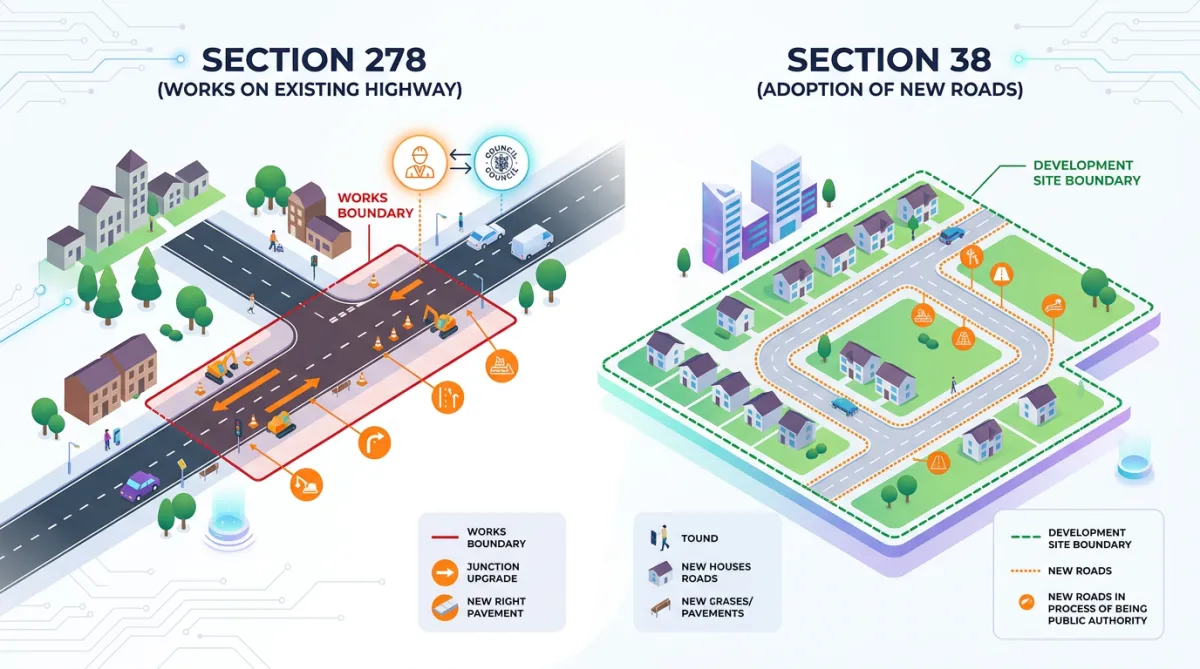
COMPARISON ANALYSIS
Section 278 vs Section 38: What's the Difference?
Discover key distinctions between modifying existing public highways (S278) and adopting newly constructed residential roads (S38), including liabilities and inspection phases.

TIMELINES & PROCESS
How Long Does a Section 278 Agreement Take?
Realistic stage-by-stage timelines from initial feasibility and technical submission (Form S278) to legal engrossment, road closure orders, and site execution.
KNOWLEDGE BASE & INSIGHTS
Latest Articles & Resources
Explore strategic perspectives, technical breakdowns, and tactical guides curated for modern leaders.
STRATEGY
Mastering High-Velocity Funnel Optimization
Discover proven data models and behavioral psychology frameworks that turn cold visitors into high-value repeat customers.
6 min read • Strategy & Growth
DESIGN
Crafting Visual Hierarchy That Converts
Learn the core compositional techniques top digital designers use to command user focus and eliminate cognitive friction.
4 min read • UX & UI Systems
TECHNOLOGY
Next-Gen Architecture for Web Performance
Explore how modern modular infrastructure and edge compute deliver sub-second load times across global networks.
8 min read • Infrastructure
GROWTH
Scaling Customer Acquisition Profitably
A tactical breakdown of sustainable multi-channel acquisition tactics that keep CAC low while scaling volume.
5 min read • Acquisition & CAC
ANALYTICS
Beyond Pageviews: Metrics That Truly Matter
Uncover the critical engagement and retention telemetry that predictive product teams use to prioritize roadmaps.
7 min read • Data & Telemetry
LEADERSHIP
Building Autonomous High-Impact Teams
Practical management structures and operating cadences designed to accelerate creative output without burnout.
5 min read • Operations & Culture
CASE STUDY
Inside an 8-Figure Enterprise Brand Overhaul
Step-by-step walkthrough of a comprehensive repositioning that increased enterprise sales velocity by 42%.
9 min read • Transformation
BEST PRACTICES
Modern Conversion Copywriting Fundamentals
Why benefit-driven clarity consistently beats clever slogans when driving decision velocity and checkout conversions.
4 min read • Conversion Copy
INDUSTRY INSIGHTS
Emerging Trends Reshaping Digital Commerce
Key technological shifts set to define consumer expectations, checkout experiences, and digital transactions.
6 min read • Commerce & Tech
What Are Section 278 Works?
Section 278 of the Highways Act 1980 allows developers to carry out works on public highways as part of a planning permission condition. We take care of all technical approvals, legal agreements, and on-site works to ensure full compliance with your local highways authority.
Comprehensive Section 278 Services
Highway Design & Planning
Including Swept Path Analysis And Detailed Drawings
Technical Approvals
We Liaise With Your Local Highways Department
Legal Agreements
We Guide You Through The Section 278 Process
On-Site Construction
Road Widening, New Junctions, Pedestrian Crossings & More
Inspections & Sign-Offs
We Oversee Final Inspections And Adoption Standards
How We Make Section 278 Simple
Free Consultation
Tell Us About Your Project
Design & Submissions
We Prepare And Submit All Required Documents
Legal & Approvals
We Manage All Communication With The Council
Works Begin
Our Trusted Contractors Complete The Job
Adoption & Completion
We Oversee Final Inspections And Approvals
What Developers Say About Us
Section278Works.co.uk took care of everything. We didn't have to chase the council once.

They know the process inside out. Saved us months of back and forth.
Why Work With Section278Works.Co.Uk?
- Experts in Highways Law & Planning Conditions
- Full Service - Design, Legal, Construction & Sign-Off
- Fast Approvals - We know what your council wants
- Transparent Pricing - Clear costs from the start
- Nationwide Coverage
Get Expert Help With Your Section 278 Works
Complete the form below and we’ll get back to you within 1 working day.
Frequently Asked Questions
What is a Section 278 Agreement?
A Section 278 Agreement (under Section 278 of the Highways Act 1980) is a legally binding agreement between a developer and the local highway authority. It allows the developer to fund and carry out permanent alteration or improvement works to the existing public highway network associated with a new development.
When do I need a Section 278 Agreement for my development?
You need a Section 278 Agreement whenever your planning permission requires alterations or improvements to the existing public highway. Common triggers include creating new access junctions, widening roads, installing traffic signals, building right-turn ghost islands, adding pedestrian crossings, or modifying kerb lines and footways.
What types of works are covered under a Section 278 Agreement?
Works covered include junction alterations (roundabouts, signalised junctions, priority junctions), right-turn ghost islands, carriageway widening, traffic signals, pedestrian and cycle crossings (zebra, toucan, pelican), footway construction and resurfacing, traffic calming measures, drainage alterations, and street lighting modifications on the adopted highway.
What is the process for getting a Section 278 Agreement approved?
The process involves four key stages: 1) Initial consultation and feasibility review with the local highway authority; 2) Detailed highway design, swept path analysis, and technical submission; 3) Highway authority technical approval, legal drafting, and agreement of bond figures; 4) Execution of the legal agreement, payment of council fees, provision of the surety bond, and issue of permission to construct.
How long does it take to get a Section 278 Agreement in place?
Typically, obtaining technical approval and completing a Section 278 Agreement takes between 3 to 6 months for straightforward schemes, and 6 to 12 months for complex junction or signalisation works. Engaging early and providing fully compliant technical submissions significantly reduces delays.
What costs are involved in Section 278 works?
Costs include design and engineering fees, highway authority checking and inspection fees (usually a percentage of the estimated works value), legal fees, statutory undertaker/utility diversion costs, surety bond fees, the physical construction cost, traffic management, and any commuted maintenance sums required by the council.
Do I need to provide a bond or cash deposit?
Yes. Highway authorities require a financial surety (either an insurance bond or cash deposit) covering 100% to 120% of the estimated cost of the works, plus highway authority fees. This protects the council if the developer fails to complete the highway works or goes into liquidation.
Can I start the highway works before the agreement is signed?
No. You cannot commence works on the public highway until the Section 278 Agreement has been formally completed, all required approvals and permits are in place, the bond is secured, and road space/traffic management permits are granted. Starting unauthorized works on the public highway is illegal.
Who is responsible for the construction under a Section 278 Agreement?
Depending on the highway authority's policy, works are either carried out directly by the developer using an approved highway contractor (with council inspection) or, in some authorities, commissioned by the council at the developer's expense. As an approved contractor, Section278Works.co.uk manages the entire construction process to highway standards.
What happens once the highway works are completed?
Upon substantial completion, the highway authority inspects the site and issues a Certificate of Substantial Completion (Provisional Certificate). This triggers a 12-month maintenance/defects liability period (during which the bond is typically reduced to 10%–20%). The developer remains responsible for repairing any defects arising during this year.
Will the council adopt the highway after completion?
Yes. After the 12-month maintenance period expires, a final joint inspection is carried out. Once any outstanding remedial defects are corrected and safety audits are completed, the highway authority issues the Final Certificate and the works form part of the publicly maintainable highway.
What's the difference between Section 278 and Section 38?
A Section 278 Agreement covers alterations to the existing adopted public highway. A Section 38 Agreement covers the construction of new internal estate roads (such as within a new housing development) that will subsequently be offered to the local highway authority for future public adoption and maintenance.
Can Section 278 works include traffic signals or new access roads?
Yes, Section 278 works frequently include permanent new access roads connecting into the adopted highway, junction signalisation, MOVA/SCOOT traffic control systems, detector loops, pedestrian signal phases, and associated electrical ducting.
What if the works are delayed or not completed properly?
If works are delayed or fail to meet the council's specification, the highway authority has the legal power under the agreement to step in, use the surety bond or cash deposit to complete the works or rectify defects, and charge all associated administrative and legal costs to the developer.
Let’s Get Your Section 278
Agreement Moving
From technical drawings to final sign-off, we handle it all

Helping You Navigate Highway Agreements with Ease
Social Media Links

Part of R W Services Contractors Ltd
